Rice thresher spare parts: what to order with your first container
Teeth, screens, belts, bearings and fan parts wear first. A practical guide to choosing spare parts for rice threshers and shipping them in the same container.
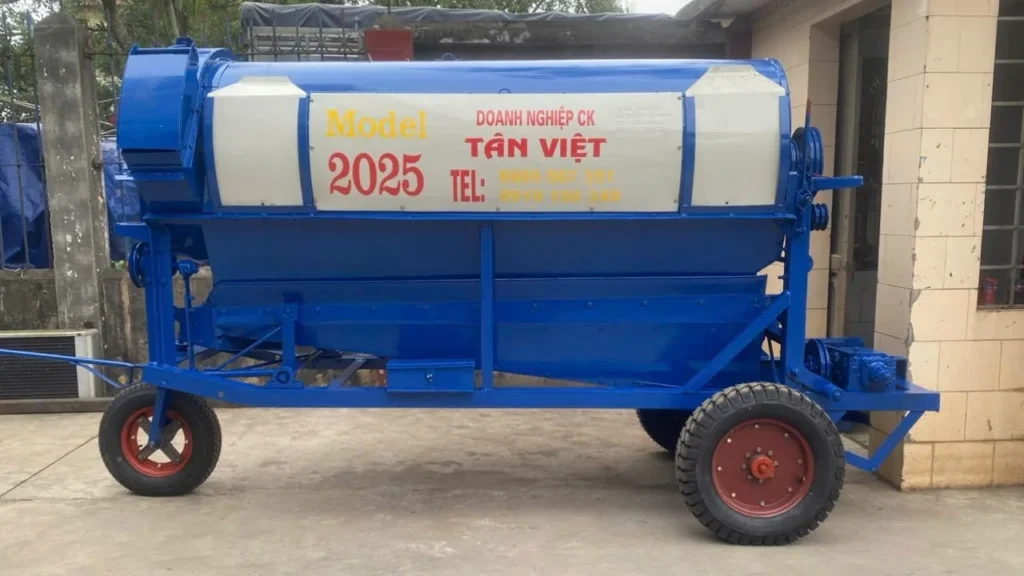
Order the parts that touch the crop and the parts that turn: threshing teeth, sieve screens, fan parts, belts and pulleys, bearings, and sprockets with chains. Send them in the same container as the machines. A thresher that stops during harvest costs more than the parts, and a second shipment arrives too late.
Why order spare parts with the first container?
Threshing is seasonal work. When a machine stops in the middle of the harvest, the grain waits in the field and the contractor loses days that do not come back. Ordering parts later means a separate shipment, extra freight and weeks of waiting. Ordering them with the first container means the parts are in your store before the first breakdown.
Which parts wear first?
These are the wear parts we supply for our Tân Việt rice threshers:
| Part | Why it matters |
|---|---|
| Threshing teeth | Heat-treated alloy steel, they strike the crop and wear first. Supplied in boxes of 100 teeth, and each tooth can be replaced on its own. |
| Vibrating sieve screens | Punched to suit tropical paddy grain sizes. Worn or clogged screens let waste through into the clean grain. |
| Fan and blower parts | Dynamically balanced. They create the airflow that separates chaff from grain. |
| Pulleys and V-belts | Cast-iron pulleys and heat-resistant B and C section belts carry the drive from the engine to the machine. |
| Bearings and pillow blocks | Sealed against straw dust, which is the usual enemy of a bearing in a thresher. |
| Sprockets and chains | Part of the drive train, kept oiled for the sea voyage and checked in the first weeks. |
How do you decide how many to order?
We do not print a one-size list, because the right quantity depends on your fleet. Work through it like this:
- List the models and the number of machines. Parts are sized per model: we export the HT-1200×600 compact, the HT-2000×700 standard, the HT-2200×700 long chamber and the HT-2000×800 heavy-duty.
- Estimate the hours each machine will run in a season. More hours mean more teeth, belts and screens.
- Start with the parts that touch the crop, then the belts and bearings.
- Send us your models and quantities with your quote request, and we will discuss a suitable set to compare with your own estimate.
What about the diesel engine?
Our machines are designed for diesel engines of about 8 HP for the compact model, 15.5 to 16.5 HP for the standard and long-chamber models, and 20 to 24 HP for the heavy-duty model. Ask which engine will be fitted, so you can stock matching oil and filters from a local supplier.
How are spare parts shipped?
For a 20 ft container we pack a spare-parts set in the same box as the machines. Parts travel boxed, and the teeth go in boxes of 100. On the paperwork, spare parts are usually a separate line from the machines, with their own HS code (HS 8433.90 covers parts of this machinery). Read the export documents checklist to see how to keep the invoice and packing list consistent.